Wondering whether a Sarasota lot is a smart tear-down or infill opportunity, or a costly mistake in disguise? In this market, that question matters more than ever because true vacant land is limited and many opportunities involve older homes, narrow lots, and established neighborhood context. If you are evaluating redevelopment potential in Sarasota, this guide will help you focus on the issues that shape feasibility before you commit. Let’s dive in.
Why Sarasota Favors Infill
Sarasota is largely built out, which is one reason redevelopment plays get so much attention. According to the City of Sarasota’s Future Land Use chapter, vacant land makes up about 5.05% of total city acreage, spread across 1,299 parcels, and only nine vacant parcels are larger than 5 acres.
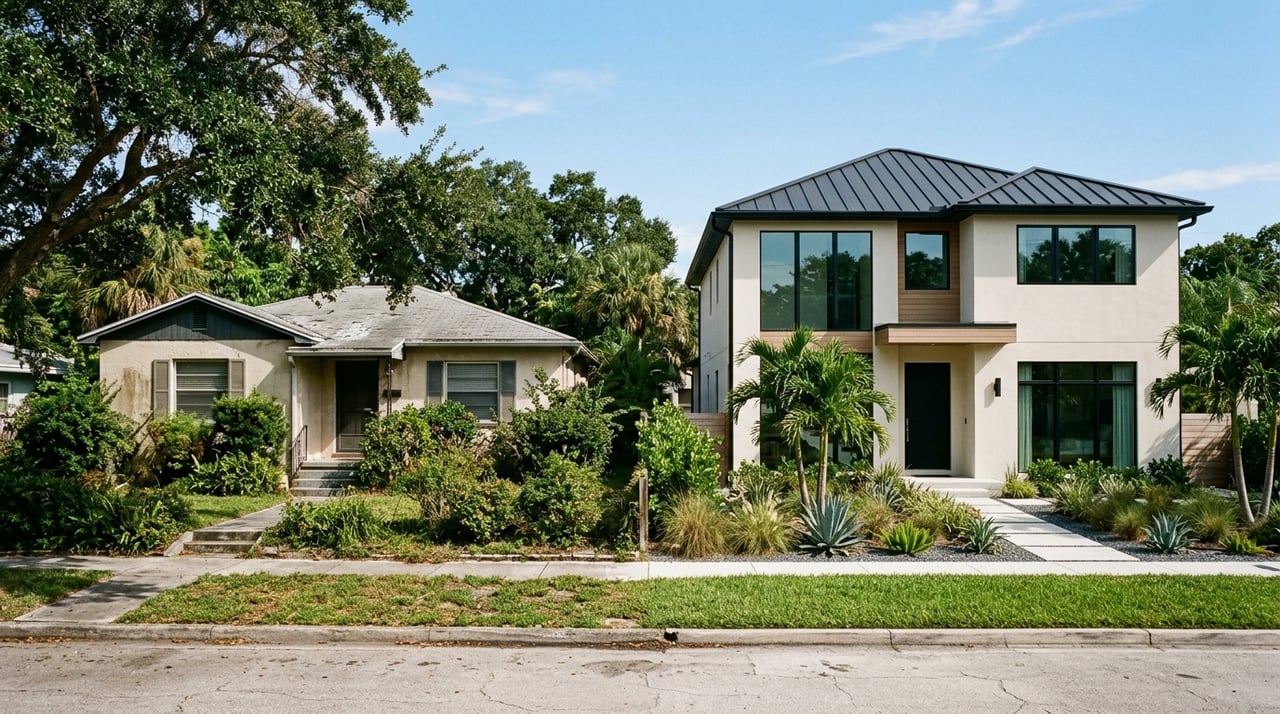
That limited supply changes how you should think about opportunity. In Sarasota, the better play is often not raw land development but replacing or repositioning an older property in the right location.
The same city document shows why. From 2020 to 2023, Sarasota issued 11,590 permits tied to new construction or remodeling, but only 595 were for new buildings, and about 73% of the housing stock is more than 35 years old. That mix points to a market where redevelopment can be just as important as new land creation.
What Makes a Lot Feasible
A promising lot is not defined by size alone. In Sarasota, feasibility comes down to how zoning, future land use, lot configuration, flood exposure, tree impacts, and historic context work together.
Before you price a site aggressively, you need to know what the parcel can legally support. The city’s Zoning division handles zoning confirmations, zoning interpretations, lot split and boundary adjustment reviews, and plat consolidations, which makes early verification essential.
Start With Zoning and Land Use
Every parcel has a base zoning district, and some also have overlays or added requirements. Sarasota’s zoning code is updated through quarterly supplements, so you should confirm both the zoning map and the current code text before going under contract.
You also need to compare zoning with future land use. The city states that density increases above what current zoning allows must be compatible with surrounding use, density, intensity, and scale, which can be especially important in established residential areas.
In Sarasota’s single-family classifications, detached homes remain the core use pattern, with only limited compatible secondary uses. That means a parcel may look attractive on paper but still carry meaningful constraints if your redevelopment vision pushes beyond the established pattern.
Narrow Lots Need Careful Review
Some of Sarasota’s infill opportunities sit on narrower lots where boutique new construction may be possible, but only after close code review. The city recently approved zoning text amendments that removed the two-story cap in RSM-9 while keeping the maximum height at 30 feet, and it also adjusted tree rules for lots with 30-foot frontage or less.
That matters because it shows the city is actively refining how infill works on constrained parcels. If you are evaluating a narrow lot, do not assume a recent nearby build guarantees the same result on your parcel.
Established Neighborhoods Change the Equation
In Sarasota, older neighborhoods often bring more design and review considerations than buyers expect. This is especially true in established areas near downtown and west of trail, where redevelopment may involve more than just standard zoning analysis.
The city’s Historic Preservation Plan identifies several older neighborhoods and potential historic districts, including Granada and McClellan Park. It also notes that Laurel Park was formally nominated and should remain primarily single-family with preserved height and scale.
For you as a buyer or investor, that means neighborhood fit can be just as important as lot dimensions. A parcel may support redevelopment in theory, but design sensitivity and preservation review can affect timing, cost, and certainty.
Laurel Park and RSM-9 Context
Laurel Park deserves special mention because the city implements that area through RSM-9, a low-density single-family district intended to preserve building height and scale. The future land use chapter also notes that a designated historic building there may be an appropriate sending site for the city’s historic-preservation development-rights transfer mechanism.
That does not mean every property in or near Laurel Park is off limits for redevelopment. It does mean you should approach teardown assumptions carefully and verify whether the existing structure, district context, or preservation status changes the path forward.
The Biggest Due Diligence Checks
The strongest redevelopment buyers usually do their risk work up front. In Sarasota, that means understanding the entitlement path before the land price assumes best-case outcomes.
Here are the main issues to review early:
- Zoning and parcel setup: Confirm zoning, future land use, setbacks, frontage, easements, overlays, and whether the property needs a lot split, boundary adjustment, or plat work through the city’s Zoning division.
- Flood exposure: Review the city’s current FEMA flood map guidance. Sarasota notes that the current Flood Insurance Rate Maps and Flood Insurance Study became effective March 27, 2024, and coastal areas may be affected by Coastal A Zone and LIMWA designations.
- Historic status and demolition limits: Check whether the structure is older than 50 years or may trigger review under the city’s historic preservation rules. The city states that certain eligible or contributing historic structures will not receive a demolition permit until the Historic Preservation Board finds mitigation measures have been undertaken.
- Tree impacts: Review tree removal requirements through the city’s Tree Protection page. Sarasota requires a tree removal permit for any tree larger than 4.5 inches DBH, even if the tree is dead or a prohibited species.
- Application path: Some projects may require review through the city’s Development Applications division, which processes rezones, site plans, zoning variances, historic designations, and certificates of appropriateness.
When a Community Workshop May Be Required
One overlooked piece of Sarasota redevelopment is public process. Depending on the type of request, you may need a community workshop before a formal application moves ahead.
The city’s community workshop requirements apply to rezonings, future land use amendments, site plans, street vacations, some text amendments, NTOD use, and certain LPOD-related applications. The city also requires notice to properties within 500 feet at least 14 days before the meeting.
If your deal depends on a rezoning or similar approval, this step should be built into your timeline from day one. It can affect both carry costs and closing strategy.
Coastal Sites Need Extra Caution
Not every Sarasota redevelopment site carries the same risk profile. Coastal parcels may come with added flood and planning considerations that deserve extra scrutiny.
The city says projects in special flood hazard areas must use the current FEMA maps, and the future land use chapter adds that the Coastal High Hazard Area should be weighed carefully before increasing densities or intensities because of safety and evacuation concerns. For waterfront and near-water parcels, that is a critical part of the underwriting conversation.
What the Market Signals Mean
A good redevelopment opportunity still has to make sense in the broader market. According to January 2026 Sarasota County single-family data from RASM, the median sale price was $490,000, with 3,444 active listings and 5.0 months of inventory.
RASM describes 5.5 months as a balanced-market benchmark, so Sarasota County was sitting slightly below that level. For you, that means redevelopment decisions should still be disciplined. Demand may support quality new product, but entitlement surprises can quickly erase margin.
A Practical Way to Evaluate a Site
If you are comparing tear-down or infill opportunities in Sarasota, use a simple screening framework before you focus on price.
1. Confirm What Can Be Built
Start with current zoning, future land use, frontage, setbacks, and any overlays. If the site needs a lot split, variance, rezoning, or plat work, treat that as part of the acquisition risk, not an afterthought.
2. Review Physical Constraints
Check flood maps, trees, easements, and access. On tighter urban lots, small physical constraints can materially change design options.
3. Evaluate Existing Structure Risk
If the home is older, verify whether historic review could affect demolition timing or feasibility. In established neighborhoods, this step can be just as important as confirming the build envelope.
4. Match the Plan to the Area
Look at the surrounding scale and development pattern. Sarasota’s land-use guidance makes clear that compatibility matters, especially where established single-family character is part of the planning framework.
5. Underwrite the Approval Path
If your project needs more than a straightforward permit, estimate the time and cost for workshops, applications, hearings, and revisions. A site with a clear path can be more valuable than a cheaper parcel with unresolved entitlement issues.
Why Local Guidance Matters
In Sarasota, redevelopment success often comes from spotting the real constraint before you buy. That might be a narrow frontage issue, a tree removal challenge, a flood designation, a neighborhood scale concern, or a demolition review tied to historic status.
An experienced local advisor can help you screen these variables early, when you still have leverage and options. That kind of front-end clarity is especially valuable in Sarasota’s luxury land and infill market, where the wrong assumption can be expensive.
If you are weighing a tear-down, infill lot, or redevelopment parcel in Sarasota, working with a steady local expert can help you move with more confidence. For tailored guidance on Sarasota land, waterfront, and redevelopment opportunities, connect with Pamela Hagan.
FAQs
What should you verify before buying a Sarasota tear-down lot?
- You should confirm zoning, future land use, setbacks, frontage, overlays, easements, flood exposure, tree impacts, and whether historic review or a demolition delay could apply.
How common are vacant land opportunities in Sarasota?
- Vacant land is limited in the city, with the Future Land Use chapter reporting that only about 5.05% of total city acreage is vacant and only nine vacant parcels exceed 5 acres.
Do older Sarasota homes create redevelopment complications?
- Yes. Because many structures are older, you should check whether a property may be considered for historic designation or demolition review before assuming a clean teardown path.
Are narrow infill lots in Sarasota still viable?
- They can be, but they need careful zoning and design review because code details, frontage limitations, tree rules, and neighborhood scale all influence what can actually be built.
When does a Sarasota redevelopment project need a community workshop?
- A workshop may be required for rezonings, future land use amendments, site plans, street vacations, some text amendments, NTOD use, and certain LPOD-related applications.
Why is flood review important for Sarasota infill sites?
- Flood designations can affect design, permitting, and cost, and the city says projects in special flood hazard areas must use the FEMA maps that became effective on March 27, 2024.